LATERAL FINGER 2nd to 5th
Sagittal Projection • Lateral View of Index, Middle, Ring, or Little Finger
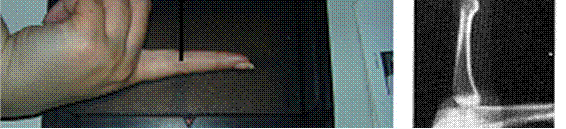
Proyección Lateral de Dedo 2º al 5º
Exposure Factors
45-50
Kilovoltage (kV)
2 - 3
mAs
Fine
Focal Spot
100 cm
SID
Performed without Bucky (direct on the IR).
Image Receptor (IR) Size
18 × 24 cm
Orientation: Longitudinal
Division: Usually divided into three parts (AP, Oblique, Lateral)
Patient Positioning
Patient seated at the end of the table with the elbow flexed 90°
Place the hand on the IR with the finger in a true lateral position
Index and Middle (2nd and 3rd): Place hand in internal lateral position (thumb side up)
Ring and Little (4th and 5th): Place hand in external lateral position (thumb side down)
Extend the finger of interest and flex the other fingers into a fist
Use a radiolucent block or tape to stabilize the finger in extension if necessary
Ensure the long axis of the finger is parallel to the IR
Central Ray (CR)
Perpendicular to PIP Joint
The CR is directed perpendicular to the Proximal Interphalangeal (PIP) Joint of the finger being studied.
Structures Demonstrated
Phalanges
Distal, Middle, and Proximal in profile
Joint Spaces
IP joints should be open
Metacarpal Head
Distal part of the metacarpal
Soft Tissue
Nail bed and finger pads
Evaluation Criteria
- Entire finger from tip to the distal portion of the metacarpal is included
- Finger is in a true lateral position (concave anterior surfaces of phalanges)
- No superimposition from adjacent fingers
- Open joint spaces (indicates the finger was parallel to the IR)
- Sharp bone detail and visible soft tissue
Routine Context
This projection is usually the third part of a finger study:
Step 1: AP/PA Finger projection (top third of IR)
Step 2: Oblique Finger projection (middle third of IR)
Step 3: Lateral Finger projection (this technique, bottom third)
Step 4: Evaluation of the three projections
Step 5: Additional projections if needed (stress, axial)
Step 6: Comparison with contralateral finger if necessary